À bribes abattues
Tags:
Description (in English):
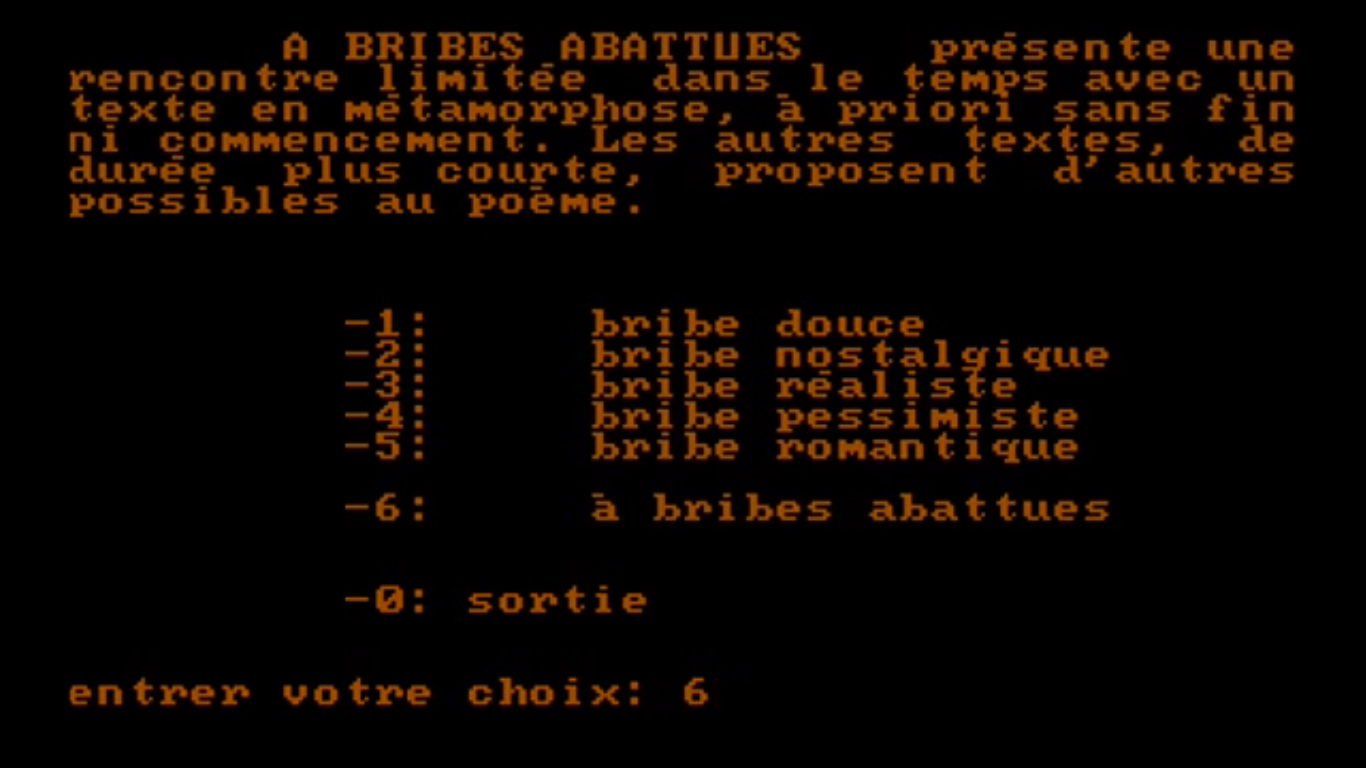
L’œuvre de Philippe Bootz « À bribes abattues » est bien nommée parce que chaque poème animé utilise les mêmes mots jusqu’à ce que leur signification soit abattue. « Bribes » fait référence aux mots individuels qui jouent sur l’écran, mais aussi aux lettres dans les mots qui changent de façon indépendante pour changer la signification des mots et des strophes. Le titre est aussi un jeu de mot avec la phrase « à bride abattue » qui veut dire « à toute vitesse. » Le lecteur choisit quelle œuvre il va « lire » (entre guillemets parce qu’on fait beaucoup plus que lire ces œuvres, on en fait une expérience). Le choix nous donne la sensation de prise, mais en fait c’est un peu comme choisir un poème dans une anthologie. On ne fait que choisir l’œuvre ou la page ; on n’a aucun influence sur le texte-même.
Puis le texte arrive et il se déplace sur la page, créant une lecture spatiale et une lecture temporelle. Plusieurs termes sont utilisés dans des quelques œuvres, y compris « toujours » et « vague. » Dans « bribe pessimiste » le mot « vague » se métamorphose de façon sémantique quand l’article « le » change à « la. » Ce genre de poésie animée crée l’occasion de faire des jeux de mots.
Le texte complet (en format limité) de « bribe pessimiste » est ainsi :
Temps que toujours
Que toujours se brise
Temps vague main/le vague toujours se brise/le temps vague main toujours se brise
La vague toujours se brise
La vague
La crête
La crête vague
La crête de la vague vague toujours se brise
La crête de la vague toujours se brise que tu construis
Il y a plusieurs façons temporelles ou spatiales de lire le texte, et j’ai ci-dessus inclus celles qui étaient évidentes pendant ma propre lecture, mais d’autres sont aussi possibles. Il est possible de « créer » des strophes parce que le texte bouge et se déplace comme une œuvre combinatoire. Après chaque vague de mouvement, le texte s’assemble en forme « strophique » pour un moment avant de s’assembler en une nouvelle strophe. L’aspect transitoire est plus évident quand le déroulement animé du poème reflète la signification du poème ; par exemple, chaque fois que le mot « vague » (soit la ou le) arrive, les lettres apparaissent et disppariassent l’une après l’autre imitant la motion d’une vague.
Description (in English):
Philippe Bootz’s work “À bribes abattues” is well named because each animated poem uses the same words until the meaning of each word is exhausted. “Bribes” refers to the individual words that play across the screen, as well as to the letters within the words which change independently in order to change the meaning of the words and stanzas. The title is also a play on words of “À bride abattue” which means “at breakneck speed.” The reader chooses which poem they will “read” (in quotes here because Bootz’s poems require much more than reading, rather experiencing). The act of choosing gives us a sense of control, but it’s more like being able to choose a poem out of an anthology of works. One only chooses the work or the page; one has no influence over the text itself.
The text appears and moves around the screen, allowing for a spatial as well as a temporal reading. Several terms are reused in several of the poems, including “toujours” (still, or always) and “vague” (wave, or vague). In the “bribe pessimiste” the word “vague” changes semantically when the article transforms from the masculine “le” (le vague = that which is vague) to the feminine “la” (la vague = the ocean wave). The genre of animated poetry allows for such play on words.
The complete, albeit limited, text from “bribe pessimiste” is as follows:
Time that always
That always breaks
Vague time hand/that which is vague always breaks/the vague time hand always breaks
The wave always breaks
The wave
The crest
The vague crest
The crest of the vague wave always breaks
The crest of the wave always breaks that you build
There are several possible temporal and spatial readings and I only included those that were most evident in my own reading. It is possible to “create” several different stanzas because the text moves like a combinatorial work. After each wave of movement the text assembles itself into a stanza of sorts for a moment, before reassembling itself into a new stanza. This transitory aspect is most obvious when the wave formation of the text reflects the content of the poem; for example: each time the word “vage” (wave, or that which is vague) appears, the letters appear and disappear one after the other, imitating the movement of a wave.
Screen shots: