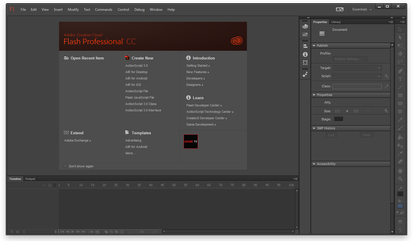
Flash
Adobe Flash can find its origins back in some original software named FutureSplash Animator released in 1995. This project combined animated media with vector graphics to create an alternative for Java developers on the web.
In 1996 this software was purchased by Macromedia. The words “Future” and “Splash” were combined to create the more familiar “Flash”. The whole software suite was devoted towards creating animations and dynamic content which could be published on the Internet. There wasn’t a whole lot of exciting possibilities until the ActionScript language was paired with the software.
The released of Flash 4 in 1999 included an overhaul of the scripting language. Developers could target graphics on the screen and call functions to animate them throughout different frames. It’s arguable that ActionScript was one of the defining programming languages which eventually pushed Flash technology further into the mainstream. By now Flash Player was already somewhat popular and growing very quickly.
By early 2002-2003 Macromedia updated the Flash/ActionScript pair with the largest innovative push forward. ActionScript 2.0 paired with the software suite Flash MX 2004 was a powerhouse for generating dynamic web content. AS 2.0 is a fully-fledged Object-Oriented programming language similar to Java or PHP or C++. You could build entire websites running on Flash – let alone custom UI panels such as video players or mp3 playlists.
(Source: Jake Rocheleau, http://speckyboy.com/2012/09/05/a-history-lesson-on-the-rise-and-fall-of-adobe-flash/)